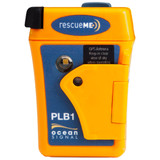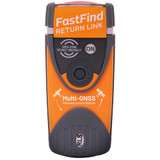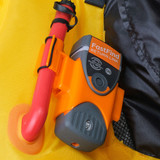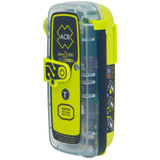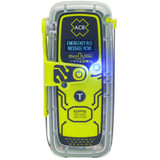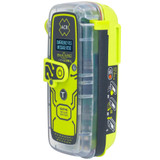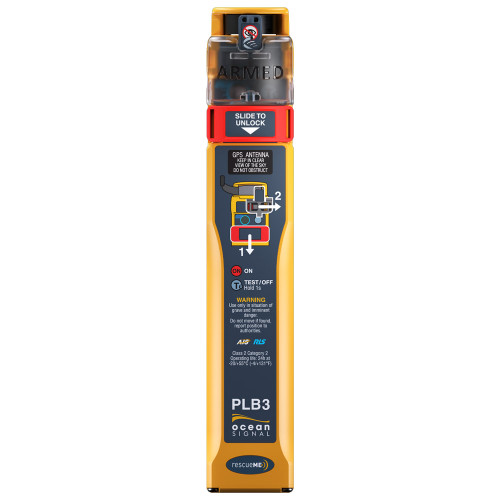






Winner of the prestigious DAME Design Award 2022, this is the world’s first personal locator beacon to combine AIS, NFC connectivity and a dedicated mobile app in one compact unit. It represents a major advancement in personal safety technology.
Designed for both marine and countryside use, the PLB3 is equally at home offshore, on coastal walks, hiking in remote areas, or working in rural environments. Wherever you are beyond immediate help, this beacon is built to provide reassurance when it matters most.
The PLB3 transmits on the global Cospas-Sarsat satellite system using the 406 MHz frequency. This network operates across three satellite constellations, ensuring your distress signal is rapidly detected and routed to search and rescue services worldwide. Once activated, your location is transmitted with an accuracy of up to 100 metres, enabling emergency teams to respond quickly and precisely.
By combining 406 MHz satellite transmission with AIS distress alerts, the PLB3 bridges the gap between global and local rescue. The satellite alert notifies international rescue coordination centres, while the AIS signal simultaneously alerts nearby AIS-equipped vessels within VHF range. This dual-technology approach significantly increases the speed and likelihood of rescue, as vessels in the immediate area can respond without delay.
Upon activation, the beacon transmits an AIS Safety Message or Man Overboard (MOB) alarm, displaying the beacon’s MMSI and live position on compatible AIS screens. Because the PLB3 appears as an active target, nearby vessels can easily navigate directly to your location.
For added visibility during recovery, the PLB3 features both a powerful white strobe and an infrared strobe. These provide a clear visual reference for rescuers during night-time operations or in poor visibility conditions, making it easier to locate you once they are on scene.
The built-in Near Field Communication (NFC) capability brings another level of convenience. Simply hold a compatible smartphone close to the beacon to open the Ocean Signal Product App and access key performance data. Users can quickly check battery status, view the number of self-tests and GNSS tests completed, and see activation history where applicable.
Detailed records are also available for each self-test and GNSS test. For every successful GNSS test, the app can display a map showing the exact test location, along with the date and time, time to first fix, number of satellites used, and positional accuracy. This gives you complete confidence that your beacon is functioning correctly and ready for use.
Whether you’re sailing offshore, kayaking along the coast, trekking through remote countryside, or exploring challenging terrain, the PLB3 delivers cutting-edge safety technology in a compact, dependable device designed to give you peace of mind wherever your adventures take you.
Return Link Service:
The Return Link Service (RLS) feature allows search and rescue authorities to send a confirmation signal back to the beacon via the Galileo satellite network. This lets the user know that their distress alert has been successfully received and that their location has been identified. Confirmation is clearly shown on the PLB3 by a flashing blue indicator light, providing reassurance that help is on its way.
Key Features:
121.5 MHz Local Homing Signal.
406 MHz Cospas Sarsat Distress Signal (MSEOSAR Compatible).
5-year battery life.
AIS Locating Signal.
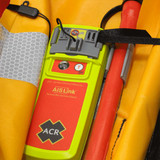
Designed to integrate with common life jackets.
FREE Ocean Signal Beacon Mobile App - available on iOS and Android.
Global Coverage.
GNSS via GPS and Galileo Satellites.
Multifunction clip system included.
Over 24 hours operational life.
Return Link Service (RLS) Functionality.
Small and lightweight.
Smartphone connectivity via NFC (Near Filed Communication).
Simple PFD attachment.
Strobe and Infrared Strobe Light.
Specifications:
General:
Activation: Manual or semi-automatic when fitted to a compatible life jacket.
Class: Class 2 Operation.
Buoyant: No.
Size (L x W x D): 20 x 2.6 x 3.0cm.
Weight: 190g.
Operational Life: Over 24 hours @ -20C.
Waterproof: Yes.
Warranty: 5 years.
406MHz Satellite Transmitter
Frequency: 406.031MHz.
Tolerance: ±1kHz.
Output Power: 5W Typical.
Modulation: Phase ±1.1radians.
Emission Designator: 16K0G1D.
Encoding: Bi-phase L.
Data Rate: 400bps.
121.5MHz Homing Beacon:
Frequency: 121.5 MHz.
Stability: ±50ppm.
Output Power (PERP): 25-100mW.
Modulation: Swept Tone AM (3K20A3X).
Modulation Factor: 0.85-1.0.
Modulation Duty Cycle: >35%.
Duty Cycle: 98%.
AIS Transmitter:
Frequency: 161.975/162.025MHz ±500Hz.
Transmit Power (EIRP): 1 Watt ±3dB.
Baud Rate: 9600 Baud.
Synchronisation: UTC.
Messages: Message 1 (Position), Message 14 (Status).
Repetition Interval: 8 messages/min. /Message 14, 2x every 4 minutes.
Infra Red Strobe:
Light Type: IR LED.
Light Colour: 850nm.
Flash Rate: 20-30 per minute.
Intensity: 7.5mW/sr.
Visible Light Strobe:
Light Type: High Intensity LED.
Light Colour: White.
Flash Rate: 20-30 per minute.
Intensity: > 1 candela.
GNSS Receiver:
Satellite Channels: 72 acquisition.
Sensitivity: -167dBm.
Cold Start: Reacquisition: -148dBm.
Battery:
Type: Lithium/Iron Disulphide (LiFES2).
Operating Lifetime: > 24 hours @ -20C.
Lithium Metal Weight (for air transport): < 2mg.
Replacement Interval: 6 years from date of manufacture.
Environmental:
Temperature Range (operational): Class 2 -20°C (-4°F) to +55°C (+131°F).
Temperature Range (storage): Class 2 -30°C (-22°F) to +70°C (+158°F).
Damp Heat (humidity): 40C at 93%.
Drop (hard surface) 1m: 6 sides.
Water Immersion: >10m (1.0bar) : > 60 minutes.
Thermal Shock: 45C into 100mm of water: > 1 hour.